Arduino Danger Shield — Learning PCB Redesign
Contents
Overview
The SparkFun Danger Shield was a popular learning board that plugged directly onto an Arduino UNO, giving beginners a rich set of inputs and outputs in one self-contained package. When SparkFun discontinued it, a replacement was designed with updated components and used as the foundation of a two-session intro Arduino class — one session to build it, one to program it.
Shield Components
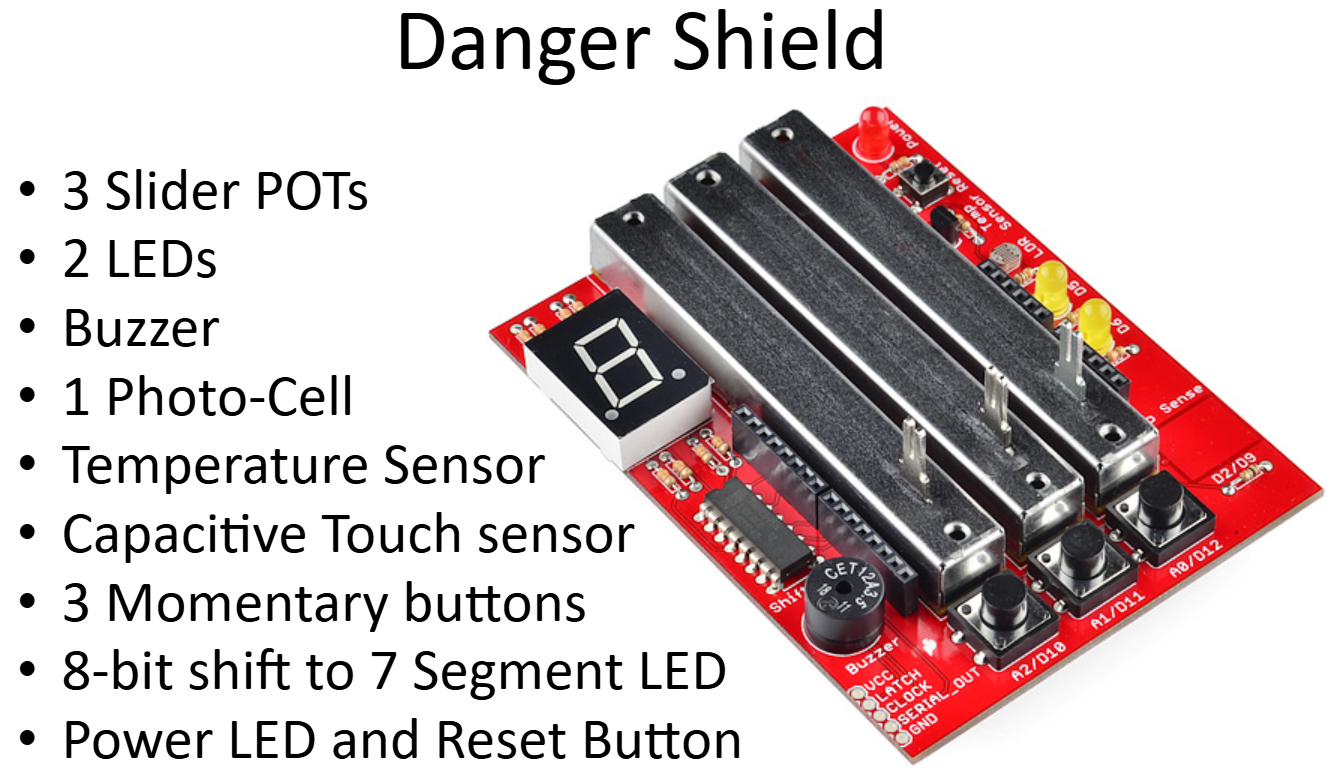
- 3 slider potentiometers (analog input)
- 2 LEDs (digital and PWM output)
- Piezo buzzer (tone output)
- Photocell / LDR (analog light sensing)
- Temperature sensor (analog, TMP36-style)
- Capacitive touch pad
- 3 momentary push buttons (digital input with internal pull-ups)
- 8-bit shift register driving a 7-segment LED display
- Power LED and reset button
The Class
Session 1 — Soldering
Students assembled the shield from a bare PCB and components, making it a hands-on introduction to soldering for microelectronics. By the end of the session each student had a working shield ready for the next class.
Session 2 — Programming
The second session used a slide deck (linked above) to walk through each peripheral individually, with a standalone code exercise for each one — the exercise code is in the GitHub repository (linked above). The session culminated in combining everything into a single sketch that read multiple sensors and drove multiple outputs simultaneously — putting all the pieces together.
Class Exercises
The second session stepped through each component as a standalone exercise:
| Exercise | Concepts covered |
|---|---|
| Blink LEDs | digitalWrite, digitalRead, delay |
| Buttons | INPUT_PULLUP, active-low logic |
| Sliders | analogRead, 0–1023 range, sprintf |
| Fade LED | analogWrite (PWM), map() |
| Temperature | ADC-to-mV conversion, TMP36 offset math |
| Slider/Tone | tone(), noTone(), frequency mapping |
| Capacitive touch | CapacitiveSensor library |
| 7-Segment display | Shift register, SPI bit-banging, shiftOut |
| PANIC | Photocell baseline + threshold, while loops |
| Servo | Servo.h, write(), sweep (servo not included on shield) |
Beyond the Classroom
The shield’s sliders and buttons also make it a handy general-purpose controller. One fun application: using it to fly a Syma toy helicopter via IR — the three sliders map directly to throttle, yaw, and pitch.
Files
Schematic and PCB files are in the GitHub repository.