Light Bulb in a Bottle — Edison Filament Reproduction
Overview
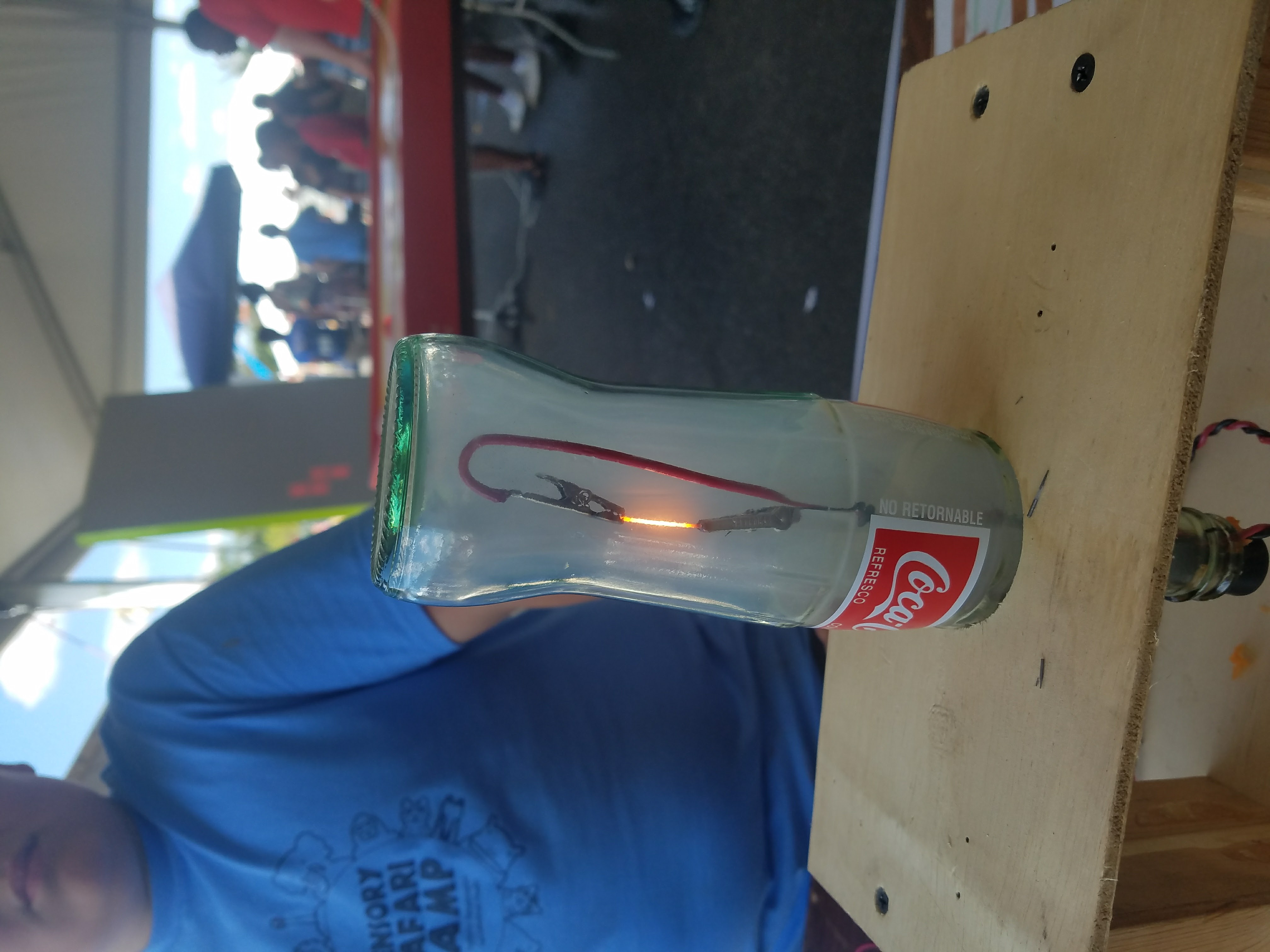
A Detroit Maker Faire demonstration showing how accessible Edison’s original invention really was. Press the switch, the pencil lead glows bright. The materials are entirely modern and off-the-shelf — the principle is 140 years old.
Construction
A graphite filament was made from the lead of a standard modern mechanical pencil. Two wires pass through a cork sealing the bottom of a glass bottle, with small alligator clips on the wire ends inside the bottle allowing quick filament replacement between demonstrations.
Power comes from a stack of D-cell batteries loaded into a PVC pipe — simple, safe, and easy for an exhibit table.
The Theory
Edison’s original bulbs worked by evacuating the glass envelope to remove oxygen, preventing the filament from combusting. The theory here was the same: the initial burn-off would consume the oxygen trapped inside the sealed bottle, allowing the filament to continue glowing in an oxygen-depleted environment.
In Practice
It didn’t work perfectly. The filament averaged about one minute of full brightness before burning out. The alligator clips made swapping in a fresh piece of pencil lead a matter of seconds — keeping the demonstration running through a full event day.